







Personal & Professional Development
Knowledge gained at university is essential, but it’s not everything. It’s important to test your knowledge in practice and to develop other skills and experiences outside of class. This way, you can build a unique set of skills that makes you stand out and gives you an advantage - not only in the job market, but in life in general.
Curious how to start and where to look for opportunities? Keep reading! You’ll also find various offers arriving regularly in your student email - club activities, invitations to lectures and workshops, announcements about study-abroad programmes. At the very least, skim the subject lines so you don’t miss anything important.
Our university expects students to be independent and proactive. Don't hesitate to explore job and internship opportunities and take an active role in shaping your career path.
Speaking in front of a class, communicating in a foreign language, managing group projects, coordinating with teammates, organizing deadlines and exams… At first glance these may seem easier than mastering complex technical knowledge, but often they are not. Soft skills, as these "minor" skills are collectively called, are and will continue to be an important part of your everyday life, so it is good to work on them constantly.
Lectures, workshops, and short courses are an easy and accessible way to broaden your horizons. Pick a topic you care about and grow in it—whether through a one-off event or regular sessions. The best part? They are free for students!
Where to find them:
- Counselling and Career Centre — especially soft-skills-oriented courses and workshops held at the school, such as communication and presentation skills, financial literacy, leadership, and stress management or relaxation techniques. Please note that not all events may be available in English.
- Coursera — online courses from prestigious universities around the world covering a wide range of topics and fields.
- National Library of Technology — courses and workshops dedicated to academic writing, citation, information search and filtering, and presentation skills.
- Maker Institute — practical technical skills, work with 3D printers, and projects with social impact using technology.
- Elective courses — subjects outside your study plan that you can enroll in freely, but compulsory courses must always come first.
- Life-long Learning Courses (LLL) — courses that broaden your horizons in topics outside your field, such as project management or media communication. These courses are free, and you can earn a certificate for some of them. The regularly updated offer can be found on the Czech webpage here. Courses where the language of instruction is English are written in English.
- Language courses — the Department of Languages offers optional courses including General English, French, German, Russian, and Spanish, as well as Business English. Foreign and Erasmus students are offered Czech language courses for foreigners. The Department of Languages also provides regular and intensive language courses for academic staff, UCT employees, and PhD students.
TIP! When considering external courses, always check quality—read reviews, ask around, and pay attention to the trainer, group size, time investment, and whether free trial sessions or individual consultations are offered.
Clubs are a fantastic way to develop teamwork, leadership, event management, budgeting, and organizational skills—all while making new friends. These experiences look great on your CV and show employers that you are active, engaged, and resourceful. Future employers are looking for active and capable people! Were you a member of the UNI-ART club? This shows employers that you are a creative person with a sense of organization. Involvement in ESN indicates experience working in an international team and a willingness to help others. And so on. In addition, you will meet many great people and can contribute to a positive atmosphere at the school.
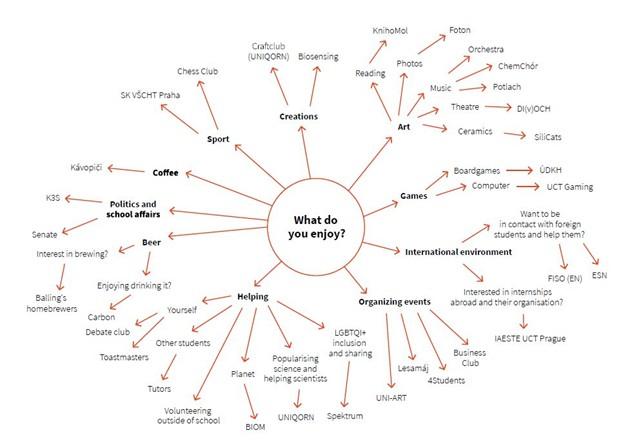
Tip: You don’t have to commit to being a permanent member right away. If you’re interested, start by attending public events. Announcements are usually sent via school email or shared on social media.
Details on existing clubs and how to join can be found on the Active page.
If you feel something is missing, you can even start your own club! Check out the handbook Clubs: Step by Step for guidance (in Czech).
Through the Mentoring programme, you can connect with professionals during your studies and get an insider’s view of different career paths. You’ll meet someone working in a role that interests you, learn what their job involves, and gain practical insights.
Mentoring is an effective way to clarify your career or academic goals while also building valuable contacts. Mentors can help with both professional and personal challenges. Even if you are not ready for a job yet, mentoring offers a low-pressure way to explore industries and roles.
Students in bachelor’s, master’s, and doctoral programmes, as well as graduates, are eligible to apply.
Information about mentors, registration, and related details can be found on the website of the Counselling and Career Centre, which oversees the service.
Taking part in competitions or presenting at conferences gives you motivation, valuable feedback, experience, and new connections—and sometimes financial rewards.
Competitions
These are regularly published on the UCT Prague website in the Science and Research section, and you can find more on the Counselling and Career Centre website.
Conferences
Don’t miss the annual Student Scientific Conference, usually held each autumn. You can present your bachelor’s or diploma project or research, win prizes, and network with industry partners.
Present your work outside of school! You can attend a conference with your paper anytime after consulting with your thesis supervisor. Conferences are a great opportunity to meet people, learn about research at other schools, and practise public speaking in front of a larger audience. You can find a conference yourself or ask your supervisor where your topic might fit. Information on how to cover conference participation costs can be found on the intranet.
TIP! To create a good presentation, use official UCT templates for presentations or posters (available via e-learning or the intranet).
Internal grants
Your projects and ideas can be financially supported through internal school grants as scientific, educational, or social projects. Information about the conditions and eligibility can be found on the IGA website.
Volunteering—whether within UCT Prague or elsewhere—is a great way to gain experience, explore roles you would not normally access, and get a glimpse behind the scenes of an organization that interests you. And that is something that will never be lost.
If you are involved in any volunteer work at school or outside of school, you can obtain a certificate for your activities, which will help you document your efforts, for example in your CV. Employers are often interested in candidates who have a variety of practical experience and skills, as these demonstrate independence, proactivity, and a desire to develop.
For more information and a form for recording your activities, visit Active webpage. The website offers more details, a form to log activities, and career counselling support to reflect on your development.
Studying or interning abroad is an excellent way to grow personally and professionally. Explore available programmes and types of mobility here.
International students can successfully find job opportunities in English, especially in international companies and academic environments. However, learning Czech can be a significant advantage when applying for jobs and can also make everyday communication with colleagues easier, helping you integrate more naturally into the workplace and local community.
We encourage students to take advantage of the Czech language courses offered by the Department of Languages at our university. Students may also consider external language courses, including those that provide preparation for internationally recognized language certificates. Such qualifications can strengthen your CV.