




Thesis
The final thesis (bachelor, master, or dissertation) and its defence is part of the successful completion of the studies. It is also one part of the State Final Examination. General information for students can be found on the intranet in the Final thesis section (info for students), or detailed below.
For specific information follow the guidelines in Directive No. A/S/961/6/2021 – Qualification Theses and Execution of State Final Examinations in Bachelor and Master Study Programmes.
For more advice and tips from a student perspective, see the Freshman's guide.
General information on bachelor and master thesis
Your thesis supervisor is your primary guide – you can ask them about anything related to your work: the writing process, content, structure, formatting, citations, or even the defense itself. Don’t hesitate to reach out if you’re unsure about something (and can’t find the answer on this website or your faculty/department pages).
Agree together on how your cooperation will work: the scope and time demands of the practical part, as well as clear deadlines and check-in points during the process. This will make communication smoother and help you avoid last-minute stress. In most cases, you’ll be expected to adapt to your supervisor’s availability.
Tip! To make your work progress more smoothly, try some strategies for productive work or task planning. Various helpful apps can support you too – you’ll find recommendations in the e-learning course Learning, Mental Wellbeing, and Life Management.
The final thesis can also be completed outside of school (e.g. at the Czech Academy of Sciences, in a company, etc.). However, the thesis must also be "overseen" by a teacher from one of the UCT Prague departments.
The internal supervisor supervises whether the final thesis formally as well as in terms of content meets the demands and general requirements of the final thesis at UCT Prague. He or she also gives the credit for the final thesis. An external trainer (at the given workplace) then manages the content and experimental content of the thesis.
The structure of your thesis (chapters, formatting, font size, paragraph layout, etc.) is fixed.
General instructions are summarized in the Thesis Template (see documents below). The template provides sample fonts, tables, citations, graphs, and instructions for individual parts.
These are general principles. Individual departments may require specific formatting or citation styles. Always check with your department and supervisor for instructions. Each department may have its own rules and conventions, so consult your supervisor for details.
The Thesis repository can be used to preview theses from previous years (thesis structure, style, etc.).
Tip! You can download the Thesis Template and work directly in it. However, it’s usually better to copy the formatting into a new Word document. Otherwise, citation software may not work properly.
Before you start writing, double-check that your thesis assignment in the SIS is up to date and matches the plan you agreed on with your supervisor.
Theoretical Part
This section is essentially a literature review – a summary of what is already known about your chosen topic. The foundation is thorough research of information in publications, scientific articles, and other sources (both electronic and printed).
You can access a wide range of scientific databases such as SciFinder, Web of Knowledge, PubMed, Reaxys, ScienceDirect, and Elsevier. Logging in with your university credentials gives you access to most articles. For a broader search, you can also use Google Scholar (a more academic version of Google).
The National Library of Technology (NTK) https://www.techlib.cz/en/ provides thousands of e-journals, books, and databases, along with extensive print collections for borrowing. Chemistry students should also explore the chemTK digital library, which offers many resources accessible via university login.
Practical Part
For chemistry programs:
The practical/experimental part usually involves analytical measurements, isolations, syntheses, or testing methods. All relevant results – what you measured, how experiments were conducted, and what you observed – must be processed and clearly documented. Keeping a detailed laboratory notebook (procedures, chemicals used, conditions, etc.) is essential. It will make writing much easier later, as you can simply build your thesis from these records.
For economics programs (School of Business):
Here, the practical part is about presenting your own solution to a selected problem. This might include calculations, analyses, or discussions. It is important that the data and results directly relate to your research problem and objectives. Be careful with the interpretation of results – always state what the data refers to, how it was collected, and what it shows. Finally, discuss your findings and show how they address your original hypothesis.
Tip! Every thesis is unique, with different demands and time requirements. In some cases, you’ll begin measurements and data analysis immediately after receiving your assignment. In others, the practical part is less intensive, and the literature review will take more time. Always build in time reserves for each step.
This is, of course, very individual. It depends mainly on the agreement with your supervisor and regular progress checks, as well as on the layout of your other study obligations. We recommend starting with small steps sooner rather than later (e.g., literature research and notes on the theoretical part) and planning your time well. Do not compare yourself to others; everyone has a different approach and different conditions.
According to the rules of good scientific practice, you must cite everything that you have taken from external sources both word for word and in terms of content.
Each external work (article, image, etc.) must be properly cited in the thesis i.e. the source must be indicated. It is useful to use citation programs, e.g. EndNote. The license for EndNote is offered by the university for free. Citation style guidelines, EndNote, and other information can be found on intranet.
ATTENTION – each department requires different citation styles! You can easily change these throughout your document using EndNote. Always consult your supervisor about the required styles for your thesis!
- Department of Biotechnology – ready-made template for EndNote
- Web application for generating individual citations (2012)
Without properly citing the source of someone else's work, the author commits plagiarism. More on this issue:
Not only with citations but also with searching for suitable sources or general writing of an academic text, the series of lectures/webinars "How to write a final thesis" (organized regularly and free of charge by the National Library of Technology) can help you. You can find the current program and listed dates on the library' website.
Notice as of March 20, 2023
In particular, we point out that the outputs provided by artificial intelligence do not have a direct relationship to the known truth (in popular terms, "AI is sometimes mistaken and makes in fact incorrect statements"). Therefore, all claims including possible references must be separately verified which is the full responsibility of the author. We recommend all users of artificial intelligence to familiarize themselves with the issues of these tools in detail.
The materials prepared by the software themselves are not considered to be original work at this time, which would have to be cited directly. However, if you use assistance tools to process your work, you must mention in the appropriate part of the work which tools and to what extent they were used (e.g. by listing the chapters in which such materials were used).
We recommend you consult your supervisor about the intention of using AI when writing your thesis.
Some final theses might contain data for which the publication is required to be delayed by law. This is particularly the case when:
- The thesis is being developed in cooperation with a partner from the application field (the concluded contract contains a requirement to postpone publication).
- The work is being developed within the framework of the GAČR/TAČR project which requires a time delay in the publication of the results.
- If the protection of an object of industrial property (especially a patent or a utility or industrial design based on the results contained in the final thesis) is planned.
Postponement of publication is requested by the supervisor. The work marked in this way is then governed by special rules for submission (more information here), printing and defence.
For complete information and instructions, please refer to the Directive A/S/961/6/2018: Defence and storage of theses with deferred publishing (see document).
Bachelor thesis
For general writing, printing and submission procedures, please refer to the Guidelines for Authors of Bachelor Theses. Always check with your supervisor whether the procedure is different at your department.
Each faculty/department has a different principle of listing topics, see below. In addition, it is possible to make individual arrangements with the supervisor from your department/faculty (or externally) on a specific topic, and the enrolment is then governed by the supervisor's instructions.
- FCHT – The students will receive an invitation to a meeting with the vice dean regarding the possible topics for the final thesis by the end of the 4th semester. Based on the preferences and interests of the student, the vice dean will recommend a suitable topic and possible supervisor and guide the student in the following steps.
- FET – Topics are listed in SIS – it is necessary to check them regularly. You can find more information about topics and research groups in SIS and on the websites of individual departments. Moreover, the student can also approach a supervisor with his/her own proposal for a topic during his/her studies (for example at the end of the 2nd year).
- FPBT – Students usually approach a supervisor with their own proposal for a topic during his/her studies (for example at the end of the 2nd year). The topic must be approved by the guarantee of the study programme.
- FCHI – The student can approach a supervisor with his/her own proposal for a topic during his/her studies (for example at the end of the 2nd year). Nevertheless, at the beginning of the 3rd year, the Dean's office will present a selection of possible topics to the students and help them to contact the supervisors. Registration for the topic in SIS will be ensured by the Dean's Office in cooperation with the supervisor.
- SoB – Suggested topics are listed on the SoB website. The student usually agrees on the topic individually with the selected supervisor.
Don’t underestimate the importance of choosing the right topic. It’s much easier to write if you are genuinely interested in the subject and feel a personal connection to it. Take time to explore different options, browse through the available topics, and if something catches your eye—whether it’s the theme itself, the supervisor, or the laboratory—sign up or, even better, arrange a meeting with the potential supervisor to discuss the details.
If you are hesitating between several options, set up meetings with different supervisors to learn more about what each project would involve. Consider not only the topic, but also how well you think you will collaborate with the supervisor, what the team or laboratory environment is like, and other factors that may help you decide. Don’t wait too long, though—topics and supervisors can be taken quickly. If the project suits you and circumstances allow, you may even be able to continue with the same topic or research group for your master’s thesis.
Where to Get Inspiration
- Some faculties and departments organize presentations to introduce available topics. These events are a good opportunity to meet supervisors and talk with senior students.
- Tutors host various events throughout the year where you can get advice on choosing a topic and tips on how to approach your thesis in general.
- Open Day events are a great chance to look around laboratories and facilities.
- On department websites, you can explore the research focus of different scientific groups, including their projects and publications.
- Senior students can also share recommendations and personal experiences with supervisors.
TIP! If you have the time and interest, start looking into topics earlier than your study plan requires.
Follow the instructions of the study office.
After you have chosen a topic, contact the supervisor/trainer to agree on the details and to confirm that the topic has not already been assigned to someone else.
Several students might be interested in one topic, therefore do not hesitate to contact the leader/trainer as soon as possible.
If you work on an individual topic, you must follow the special instructions given by the supervisor/study office on how to apply for it in SIS.
By faculty/department
- FCHT – Students apply for listed topics in a two-round selection process; the selection and application procedure is described on the faculty website; the current status of applicants and the availability of topics are available in an online document.
- FET – Students apply for the listed topics in SIS (Work Selection section). They must then contact the relevant supervisor for approval and confirmation.
- FPBT – Students choose from the topics listed in SIS (section Selection of work), then they must contact the supervisor of the relevant work and inform them of their interest in working on the topic. The supervisor selects a researcher from among the applicants and registers the topic in SIS.
- FCHI – Students register in SIS (Work Selection section) for the listed topics, either for a pre-agreed topic or for a free listed topic (in this case, it is necessary to contact the relevant supervisor for approval).
- SoB – Registration for a topic is carried out according to the instructions of the supervisor.
Each student must have the topic of the bachelor's thesis registered in SIS by the end of the winter semester in the final year of study, see Guidelines on Final Thesis . After the student has progressed to the last semester, the study office will check the formal correctness of the assigned topic and confirm the final thesis assigned to the student. Subsequently, the final/official assignment is printed and given to the student.
Regarding the registering of the topic, always follow the instructions of your study officer or department.
The submission deadline depends on the date of the state exams: early June for the first term, mid-July for the second term. The exact submission dates for both versions (first electronic, then printed a few days later) can be found in the Academic Year Organisation.
The thesis must be uploaded to the Study Information System (SIS) and submitted in printed (bound) form to the designated location (study office, secretariat, etc.) by the specified date (Organization of the academic year) before the State final exams.
Instructions for electronic submission can be found on the intranet, including visual instructions for submitting work.
The text of the thesis and an abstract in English (in PDF format) must be submitted separately. Before submitting, check that your work is correctly formatted and that everything is as it should be – something may get ‘messed up’ when exporting to PDF format.
When uploaded, the text is automatically checked by the Theses.cz anti-plagiarism system. The boundary between original work and other work is not strictly defined; the final assessment of the degree of similarity is up to the supervisor. The basis is honest citation of sources.
Submission and Printing of the Thesis
By the deadline (see Studies – Academic Year and Teaching Schedule), you must
upload your thesis in PDF format to the Study Information System (SIS). And submit a printed, bound copy to the designated office (e.g. Dean’s Office, Department Secretariat).
Upload the final PDF version to SIS before printing and binding.
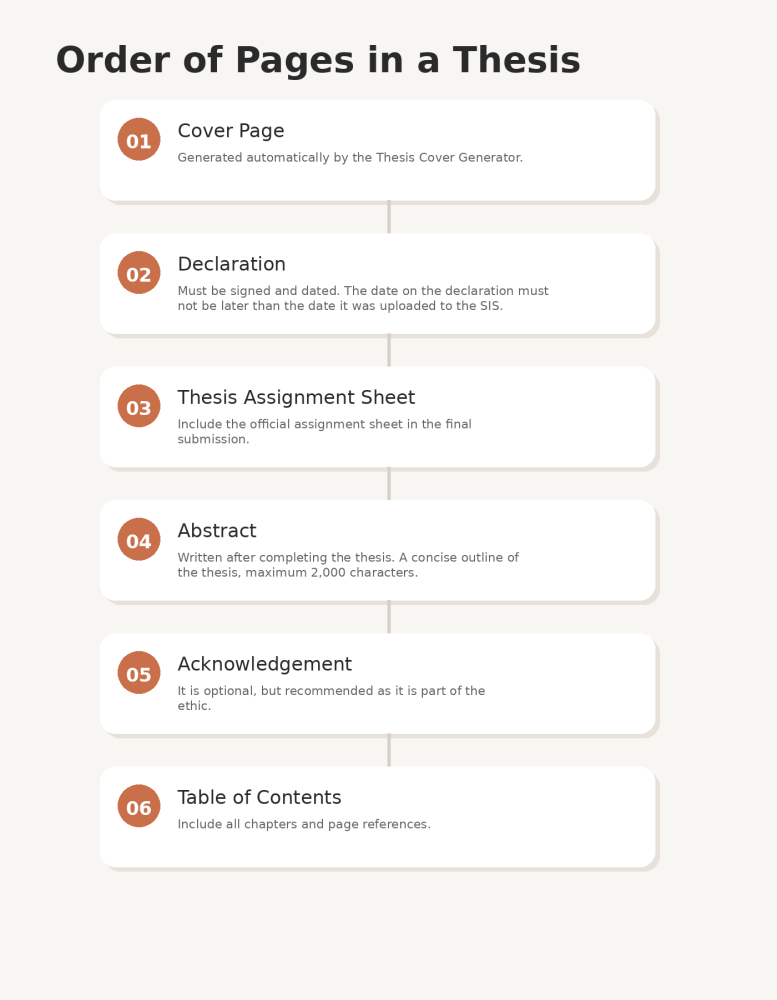
The bound copy must include the following, in order:
- Transparent front cover
- Printed cover page (generated via the Thesis cover generator)
- Introductory pages
- Title pages in English (with blank pages in between)
- Signed declaration with date
- Thesis assignment sheet
- Main text, formatted according to the official template
- Abstract (max. 2,000 characters; the same text must also be entered into SIS)
- Back cover and transparent back sheet (or laminated back cover)
The Thesis cover generator automatically inserts the thesis title, supervisor, and other required information from SIS. Download the cover and send it to the print shop together with your thesis. For technical problems with covers or formatting (not printing), contact cis-support@vscht.cz.
You can print your thesis at the UCT Copy Centre (Building B, tel. 220 44 3102, e-mail: kopirovani@vscht.cz). Please follow deadlines and instructions carefully.
At least three working days in advance, send the front and back cover (from the Cover Generator) and the introductory pages, specifying the number of copies.
- Bring your thesis in PDF format on a flash drive (also keep a Word version as backup).
- Mark which pages should be printed in color and which in black and white.
- Don’t forget to bring the original thesis assignment sheet – it must be bound into the thesis.
At UCT Copy Centre, binding is only possible using thermal binding. If you require hardcover or stitched binding, you must use external print shops/bookbinders. Always make sure their binding meets UCT requirements.
Nearby options include:
- Repro Fetterle (discounted prices for UCT students; also offers binding only if you bring pre-printed pages)
- Powerprint / Diplomka24 (printing and binding services together)
- Other local print shops that provide the required type of binding
Number of Copies and Binding by Faculty
- FCHT: 2 copies (plastic spine or other binding per department rules)
- FET: 1 copy (binding not specified)
- FPBT: 1 copy (non-removable binding)
- FCHI: 2 copies (hardcover or stitched binding with plastic or paper spine; some departments may reduce to 0 printed copies)
- SoB: 1 copy (stitched binding)
TIP! Hardcover or stitched binding is only possible for theses over ~40 pages and may take longer to prepare. Contact the print shop early and confirm printing specifications. For hardcover binding, the thesis is usually printed at 90% size—ask the print shop to handle this adjustment.
Master/Diploma thesis
General writing, printing and submission procedures can be found in the Instruction to authors of master (diploma) thesis; Always check with your supervisor whether the procedure is different at your department.
The diploma thesis has one opponent who evaluates the content and formal aspects of the thesis.
The topic of the diploma thesis is usually chosen at the beginning of the master's studies:
- As a field project at the department that runs your master's program.
- During/after completion of branch laboratories, where the student learns about the topics and agrees with the supervisor on the processing of a specific topic.
- It is possible to continue with the topic from the bachelor's thesis.
The measurement/laboratory work for the diploma thesis takes place at the department that runs the master's program, in some cases at external workplaces.
You can find the offered topics of final diploma theses in SIS.
In addition to the listed available topics, individual topics might be agreed upon with the supervisors, depending on their time and other possibilities.
Do not rush into choosing a topic and carefully consider the various options, their advantages and pitfalls. At the same time, think about the broader context of your own interests and future direction. Moreover, a dissertation does not have to be just a final piece of work. If you continue your studies at university, it could become an article for publication or the basis for your dissertation. If you are hesitating between several topics, arrange a meeting with all your supervisors or an excursion to the laboratories and explore the field. But don't hesitate too long, lest someone else ‘steal’ your chosen topic.
General principles:
- Find out about the offered master thesis topics at the beginning of your master's studies at the department that implements your master's program.
- After you have chosen a topic, contact the supervisor to agree on the details and to confirm that the topic has not already been assigned to someone else.
- Several students might be interested in one topic, therefore do not hesitate to contact the supervisor as soon as possible.
- If you work on an individually agreed topic, you have to follow the special instructions given by the supervisor/study office on how to apply for it in SIS.
You register for the selected topic in SIS.
The student applies for the topic of master thesis in SIS in the winter semester of the last year of study, see the Guidelines on the Final Thesis (see documents below).
The study office of the Faculty, after the student has progressed to the last semester of study, will check the formal correctness of the assignment and confirm the final thesis assigned to the student. Subsequently, the official assignment is printed and given to the student.
The student will receive the official assignment of the diploma thesis after registration for the last semester at the study office of the faculty or at the secretariat of the relevant department.
The master thesis must be uploaded to the Study Information System (SIS) and submitted in printed (bound) form to the secretariat of the relevant department by the specified date (see Studying - Organization of the academic year) before the State exams.
Instructions for electronic submission in SIS can be found on the intranet, including visual instructions for submitting work.
The text of the thesis and an abstract in English, pdf format, must be submitted separately. Before submitting, check that your work is correctly formatted and that everything is as it should be – something may get ‘messed up’ when exporting to PDF format.
When uploaded, the text is automatically checked by the Theses.cz anti-plagiarism system. The boundary between original work and other work is not strictly defined; the final assessment of the degree of similarity is up to the supervisor. The basis is honest citation of sources.
Instructions for the printed version of the thesis can be found on the intranet, including the mandatory set of sheets, type of binding, etc. (varies by type of work).
Generate the thesis cover according to the prescribed parameters in the online Thesis cover generator.
The Thesis cover generator automatically inserts the thesis title, supervisor, and other required information from SIS. Download the cover and send it to the print shop together with your thesis. For technical problems with covers or formatting (not printing), contact cis-support@vscht.cz.
You can print your thesis at the UCT Copy Centre (Building B, tel. 220 44 3102, e-mail: kopirovani@vscht.cz). Please follow deadlines and instructions carefully.
At least three working days in advance, send the front and back cover (from the Cover Generator) and the introductory pages, specifying the number of copies.
- Bring your thesis in PDF format on a flash drive (also keep a Word version as backup).
- Mark which pages should be printed in color and which in black and white.
- Don’t forget to bring the original thesis assignment sheet – it must be bound into the thesis.
Binding at the UCT Copy Centre is only available as thermal binding.
If you require stitched (softcover) or hardcover binding, you must use an external print shop or bookbinder. In this case, please make sure you respect the required printing and binding parameters (non-removable, stitched pages; red spine; transparent front cover; solid or transparent back cover). Keep in mind that these services may take longer—some print shops may require materials up to 14 days in advance.
Nearby options include:
- Repro Fetterle (discounted prices for UCT students; also offers binding only if you bring pre-printed pages)
- Powerprint/ Diplomka24 (printing and binding services together)
- Other local print shops that provide the required type of binding
Number of Copies and Binding by Faculty
- FCHT – 2 copies (plastic spine or other binding as instructed by the department)
- FTOP – 2 copies (binding not specified)
- FPBT – 2 copies (non-removable binding)
- FCHI – 2 copies (hardcover or stitched binding with plastic or paper spine; some departments may reduce the number of printed copies to 0)
- SoB – 2 copies (1 hardcover, 1 stitched binding)
TIP! If your work is extremely long (more than 100 pages), enter the estimated number of pages in the generator and the cover will be adjusted to your work. If your work is extremely short (less than 40 pages), contact the printer where you will be binding your work – it may be necessary to arrange for an alternative cover/print format.